


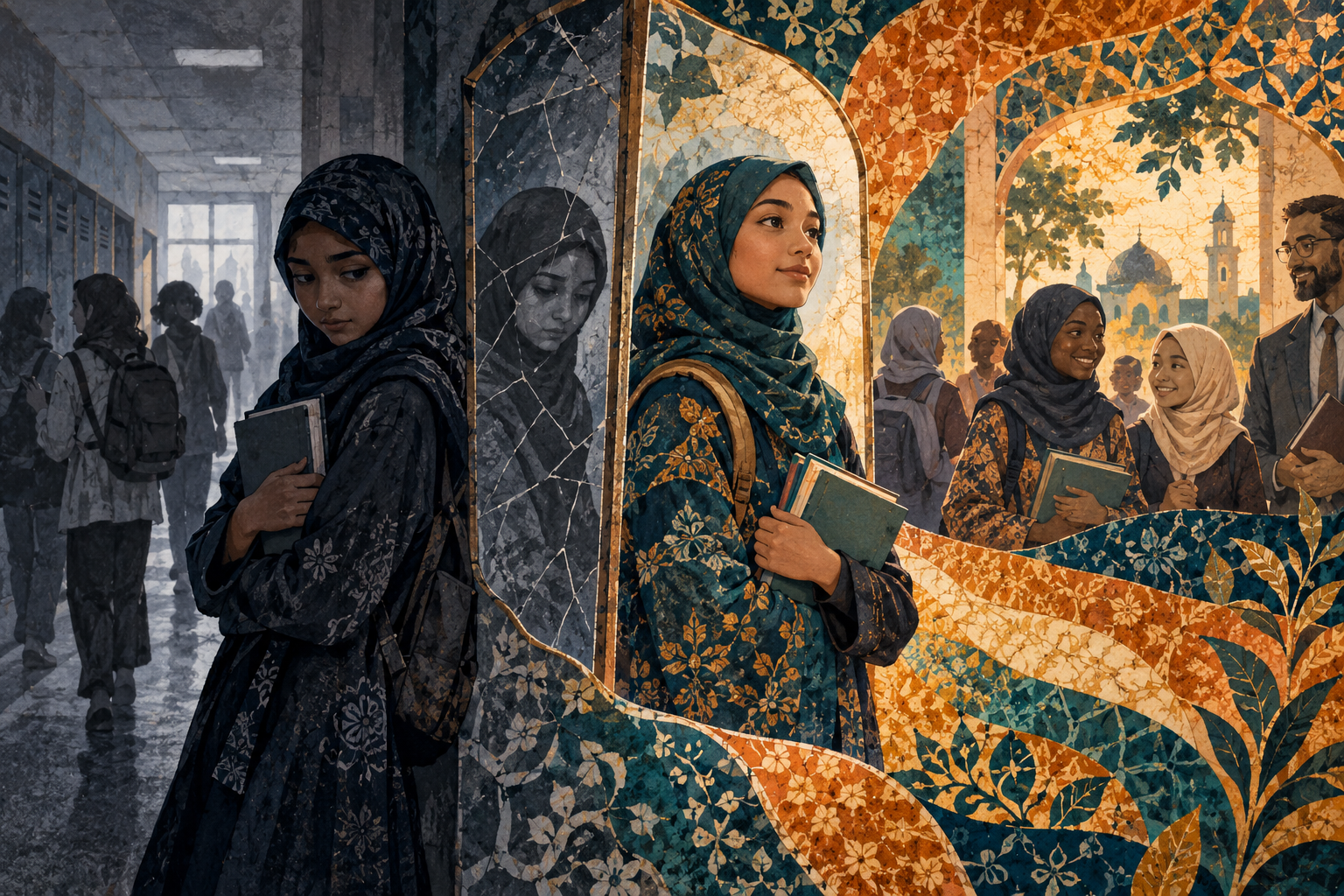
A Muslim child learns quickly which parts of home travel comfortably into school.
Their food may attract questions.
Their name may be repeatedly shortened.
Prayer may feel awkward to mention.
A girl may wonder whether hijab will change how classmates treat her.
A boy may laugh along with a joke about Muslims because objecting feels more dangerous than joining in.
Parents sometimes respond: “Do not care what anyone thinks. Be proud of who you are.”
The message is sincere. But belonging is not created by instruction alone. A child may love Islam and still feel tired of being the person who must explain it.
Do not confuse adaptation with betrayal
Children in diaspora move between linguistic, social and religious contexts every day.
They may pronounce their name differently at school. They may prefer local clothing styles within Islamic limits. They may not want every classroom discussion to turn them into a spokesperson for Muslims.
None of this automatically proves weak identity.
Adaptation becomes concerning when the child believes that acceptance requires shame, dishonesty or rejection of their faith and family.
Ask: “What do you change because it makes communication easier?”
“What do you hide because you expect rejection?”
The answers may look similar from outside but carry very different meanings.
Pride cannot be demanded while humiliation is ignored
If a child reports repeated jokes, exclusion or discriminatory treatment, telling them simply to “be strong” places the full burden on them.
A 2025 study of Muslim students in American public high schools reported substantial experiences of bullying and discrimination within its sample. The findings should not be generalised to every Muslim child, but they show why reports of mistreatment deserve careful investigation rather than automatic minimisation. Study in Professional School Counseling.
Collect specifics:
- What was said or done?
- Who was present?
- Was it repeated?
- How did staff respond?
- What effect did it have on attendance, participation or safety?
Then use the school’s reporting procedure. Identity-building at home cannot substitute for institutional responsibility where mistreatment occurs.
Do not make every difficulty Islamophobia
A classmate may mispronounce a name without contempt.
A teacher may schedule an activity during prayer because they did not know.
A child may struggle socially for reasons unrelated to religion.
Calling every uncomfortable interaction discrimination may make the child hypervigilant and reduce opportunities for clarification and ordinary friendship.
The opposite mistake—explaining away a repeated pattern—teaches the child not to trust their own experience.
Use proportionate language:
“That may have been ignorance.”
“This is a repeated exclusion.”
“We need more information.”
“This crossed a clear line.”
Accurate naming protects the child better than either denial or constant alarm.
Build identity through ordinary life
If Islam appears only when something is prohibited or when the family is defending itself, the child may experience faith mainly as conflict.
Identity grows through:
- Prayer that has warmth and rhythm.
- Quran connected to meaning, not recitation alone.
- Relationships with trustworthy Muslims.
- Service, generosity and family duty.
- Stories of Muslim scholarship, courage and ordinary goodness.
- Space to ask difficult questions without immediate accusation.
The child should know that Muslim identity is more than refusing what others do. It also offers a way to understand purpose, responsibility, mercy, worship and human dignity.
Give the child usable language
A child may know the family rule but not how to express it at school.
Practise short sentences:
“My family does not eat that, but thank you for offering.”
“I am Muslim, and this is what we believe.”
“I do not want to join that activity. Can I do the alternative?”
“That joke is not funny to me.”
“I do not know enough to answer for all Muslims.”
These are not magic scripts. Tone, age, safety and local context matter. But rehearsed language can reduce the pressure of inventing a response while embarrassed or afraid.
Belonging does not require sameness
Some individualistic accounts of identity suggest that maturity means designing the self independently of family and inherited faith.
Family and faith can certainly be misused to silence a child. But inherited belonging is not automatically a psychological burden. It can provide continuity, obligations, meaning and protection from the demand to reinvent oneself endlessly.
At the same time, parents should not treat every question as rebellion. A child who asks why may be trying to integrate faith with a world more complex than the one the parent knew.
The Qur’an describes human difference as a context for recognition, not erasure: “We made you peoples and tribes so that you may know one another.” (49:13, meaning). Knowing others does not require forgetting whom you worship or where you belong.
A weekly belonging check
Ask four questions without turning them into an interrogation:
- When did you feel comfortable being yourself this week?
- Was there a moment you wished you could disappear or blend in?
- Did anyone show curiosity or kindness?
- Is there something you want us to help with—or only listen to?
Do not demand disclosure immediately. The regular invitation matters.
A Muslim child in diaspora should not be forced to choose between faith and social competence. Our task is not to make every environment approve of them. It is to help them recognise their worth, respond wisely, seek protection when needed and participate in society without learning that belonging must be purchased with self-erasure.
Read also: When School Values Conflict With Your Muslim Family’s Values
For support tailored to your family, explore our consultations.
Related Posts
September 20, 2026
When School Values Conflict With Your Muslim Family’s Values
Muslim parents in the West may face school lessons that conflict with family beliefs. Learn…
September 12, 2026
When “Gentle Parenting” Makes Parents Afraid to Be Parents
A child refuses bedtime. The parent explains, validates, offers choices and explains again. The child…
September 11, 2026
Is Social Media Advice Quietly Rewriting Your Marriage?
A thirty-second video tells you that explaining yourself is “begging.” Another says that a partner…

September 6, 2026
Why Some Goals Survive Only in Crisis
A person ignores their health for months, then creates a strict plan after a frightening…