


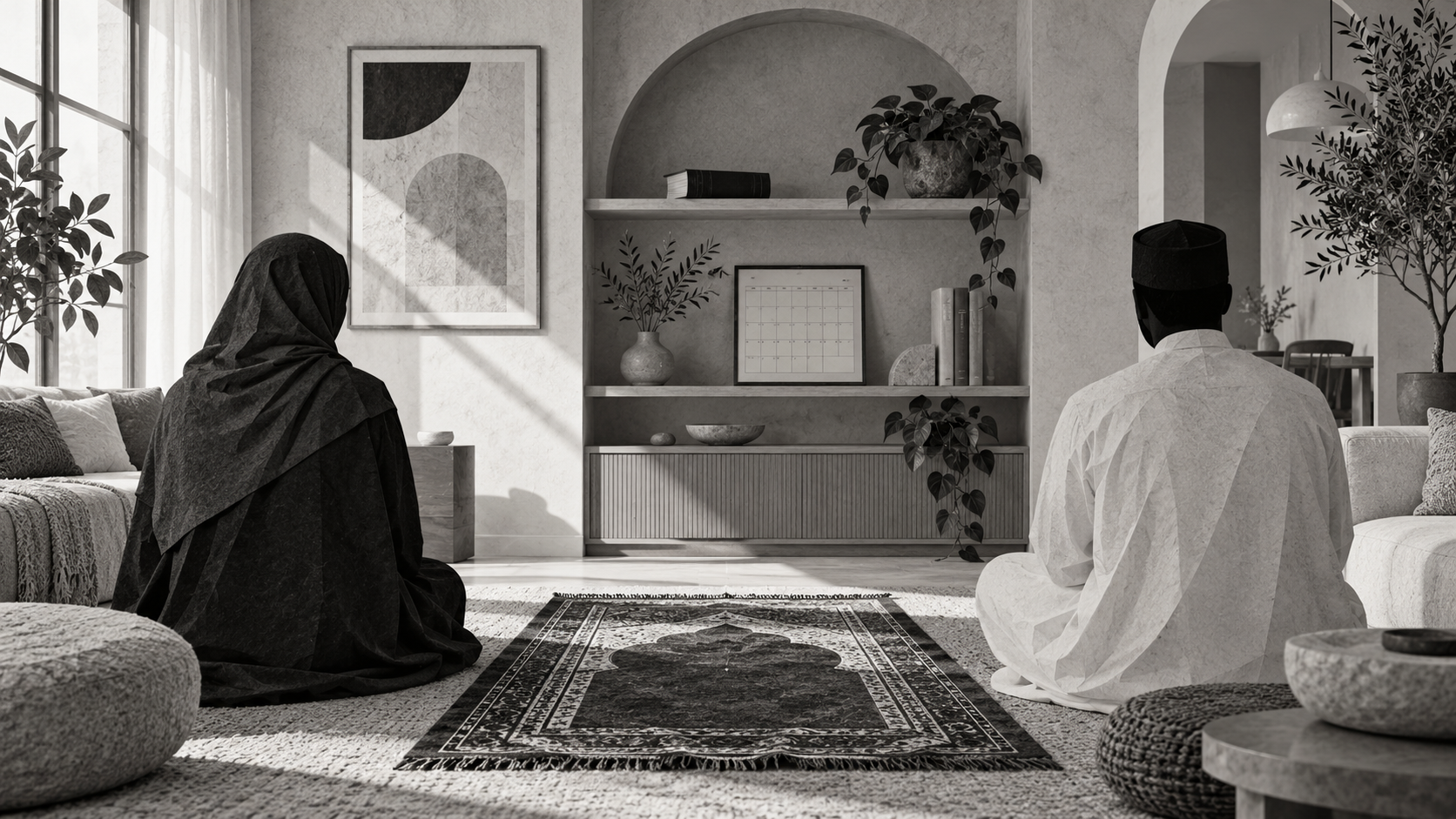
In some homes, one person becomes the manager of every religious detail: reminders, children’s routines, Ramadan planning, questions about what is permissible, family charity, the spiritual temperature of the house.
Care for a family’s faith is valuable. The strain begins when it becomes one exhausted person’s invisible job.
Shared religious practice is not a magic formula for marital satisfaction. A recent study of couples reported associations between joint practice, responsible action and relational connection, while also finding that day-to-day satisfaction was more complex. Its findings are not a religious ruling and cannot tell any one family what to do. Study details
Guidance is not the same as carrying everyone
One spouse may be more organised, knowledgeable or visibly motivated. That can be a gift. It becomes a burden when the same spouse must initiate every conversation, monitor every routine and absorb the disappointment whenever the plan fails.
Faith is not best learned as a household performance managed by one adult. It is also seen in a spouse who notices a need, begins a good action, keeps a promise and makes return easy after a lapse.
Move from reminders to shared ownership
Rather than asking, “Why do I have to keep telling you?” try to agree on one responsibility each person begins without being chased. One might protect a screen-free evening. Another might prepare a simple family reading time. Another might take the lead on a regular act of service.
The task should be real but proportionate. A home does not become more religious because its schedule becomes impossible.
Do not weaponise disappointment
Religious language should not become a sharper form of criticism: “You are failing the family spiritually.” That kind of sentence may provoke compliance for a moment while damaging trust for much longer.
Islamic responsibility includes mutual counsel and mercy. It does not ask one spouse to become the other’s inspector, nor does it excuse an adult from the effort of guiding themself.
A small weekly question
Ask: “What is one practice that would make this home more peaceful and more obedient to Allah this week?” Then choose one action that both people can recognise, rather than an ideal neither can sustain.
The aim is not a flawless household. It is a home in which faith brings responsibility, steadiness and mercy—and in which no one has to carry its entire weight alone.
Related Posts

October 18, 2026
Rebuilding Physical Closeness When Marriage Has Become All Logistics
Some marriages do not lose affection. They lose unstructured attention. The couple becomes exceptionally capable.…

October 18, 2026
When Physical Intimacy Starts to Feel Risky After Years of Marriage
A couple can share a home, raise children, manage money and care for one another—and…

October 8, 2026
When Family Group Chats Become a Second Living Room
Family group chats can strengthen connection—or turn ordinary family life into a constant audience. The…

September 24, 2026
A Family Needs More Than a Private Life
A family can be busy, responsible and affectionate—yet gradually become closed in on itself. The…